Almost every business, no matter how modern its tech stack looks today, started managing its spending the same way: a spreadsheet. Someone opened Excel, made a few columns for supplier, amount, and date, and called it a system. It’s a genuinely reasonable place to start — and for a small team with a handful of purchases a month, it works fine.
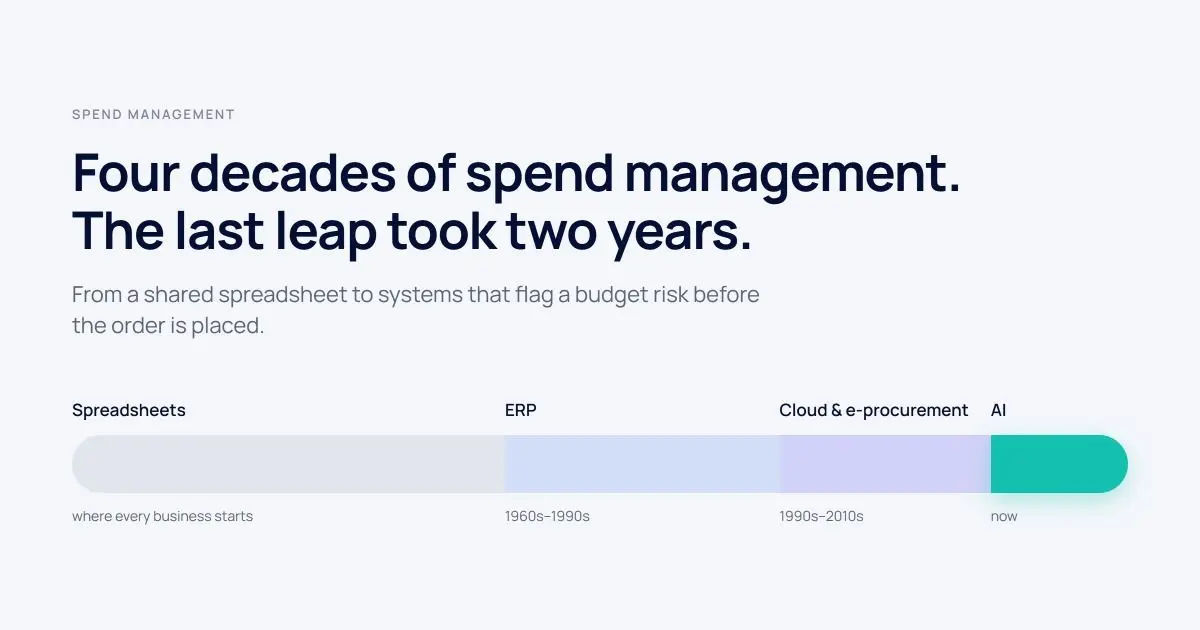
The interesting part isn’t that businesses start there. It’s how far the technology has come since, and how fast that evolution has accelerated in just the last few years. What used to be a decades-long march from paper to computers is now compressing into a few AI-driven years. Here’s how business spend management software actually got from a spreadsheet to where it’s headed next.
The spreadsheet era: simple, flexible, and eventually the bottleneck
Spreadsheets became the default business tool for a good reason: they’re flexible, universally available, and nobody needs training to open one. For early-stage companies, a shared Excel file tracking purchases, budgets, and suppliers is genuinely sufficient.
The trouble is that spreadsheets don’t fail loudly. They fail quietly, as a business grows past the point where one person can keep a mental model of what’s in every tab. Multiple versions start floating around. Nobody can say with confidence what the “real” numbers are. Approvals happen — if they happen at all — over email, disconnected from the sheet itself. And nothing stops a purchase from happening before anyone signs off on it, because a spreadsheet is a record, not a control.
This isn’t a criticism of the tool. Excel was never built to be an approval workflow, a supplier database, and a real-time budget tracker at once. It became all three by default, simply because nothing else was in place yet.
The ERP era: putting every department on one shared system
The next real leap forward didn’t start in procurement at all — it started in manufacturing. In the 1960s, factories began using Material Requirements Planning (MRP) systems to track inventory and production schedules on mainframe computers that, at the time, could fill an entire room. Through the 1970s and 80s, these systems expanded into MRP II, covering more of the production process, not just materials.
By the 1990s, this evolved into what we now call ERP — Enterprise Resource Planning. Gartner coined the term to describe a new generation of systems from companies like SAP, Oracle, and PeopleSoft that did something genuinely new: instead of separate systems for finance, HR, manufacturing, and purchasing, everything lived in one shared database. For the first time, a purchase order and the budget it drew against and the invoice it eventually generated could all reference the same underlying data.
This was a massive step up from spreadsheets, but it came with real trade-offs. Early ERP systems were expensive, complex, and typically took months — sometimes years — to implement. They were built for large enterprises with the budget and IT staff to support them, which meant most growing businesses simply couldn’t access this level of integration yet.
The e-procurement and cloud era: the internet changes who can access this technology
The internet changed the economics of this problem. In the mid-1990s, the first online procurement platforms emerged — companies like Ariba launched systems built specifically around the idea that the internet could connect buyers and suppliers directly, with digital catalogs and online purchase orders replacing paper and fax. It was enough of a shift that when SAP eventually acquired Ariba for $4.3 billion, it marked a real turning point: procurement technology had become valuable enough, on its own, to justify a multi-billion-dollar acquisition by an ERP giant.
Through the 2000s and into the 2010s, cloud computing reshaped this landscape again. Cloud-based platforms — SaaS tools accessed through a browser rather than installed on a company’s own servers — eliminated the need for the complex on-premise setups that had kept smaller businesses locked out of ERP-level functionality. This is the era that produced platforms like Coupa and Ivalua, and it’s when smaller and mid-sized businesses genuinely got access to procurement technology that used to be exclusive to large enterprises.
This era also changed who actually used the software. Older ERP systems were built for specialists; cloud procurement tools were built with ordinary employees in mind — intuitive interfaces, mobile access, and approvals that could happen from a phone rather than requiring someone to be at a specific desktop terminal. Procurement stopped being something only a dedicated department touched and became something more people across a company could interact with directly.
The AI era: from recording spend to predicting and preventing problems with it
The current shift, happening right now, is arguably bigger than any of the ones before it — and it’s happening much faster. Weekly use of generative AI within procurement functions jumped 44 percentage points between 2023 and 2024 alone, and current surveys put weekly AI use among procurement executives at 94%. Roughly 80% of chief procurement officers say they plan to deploy generative AI more broadly within the next three years. This isn’t a wave of pilot projects — these are becoming standard, production features.
What’s actually changing under the hood is a shift from software that records what happened to software that predicts and prevents problems before they happen:
Predictive analytics now forecast demand and flag likely price increases by analyzing historical purchasing patterns alongside market and even external data like weather trends — informing sourcing decisions before a shortage hits, not after.
Machine learning can detect anomalous purchasing behavior automatically, flagging patterns that look like fraud or policy violations that a manual review would likely miss.
Natural language processing drafts and reviews contracts in minutes rather than the days or weeks manual legal review used to take, extracting key terms and flagging deviations from standard language automatically.
Agentic AI — systems that can carry out multi-step tasks with less direct human input — is starting to handle discovery and shortlisting of suppliers, initial evaluation of bids, and increasingly autonomous negotiation within predefined boundaries.
The practical effect of this shift is that spend management software is becoming less about recording transactions after the fact and more about actively guiding decisions as they’re being made — flagging a budget risk before an order is placed, surfacing a supplier risk before a contract is signed, catching a pricing discrepancy before an invoice is paid.
Where this leaves growing businesses today
The interesting thing about this evolution is that each era used to be gated by company size — spreadsheets for small teams, ERP for large enterprises with big IT budgets, cloud SaaS finally opening the door for mid-sized companies in the 2010s. The AI era is compressing that gate further still: modern platforms are increasingly designed to give a growing business the kind of predictive, automated spend management that used to require enterprise-scale infrastructure, without the multi-year implementation that used to come with it.
This is the specific gap platforms like APSentra are built around: an AI-driven spend management and procurement platform that connects to whatever accounting or ERP systems a business already runs — NetSuite, SAP, QuickBooks, and others — rather than requiring a company to rebuild its tech stack around one vendor’s system first. It brings the AI-era capabilities described above — real-time budget checks, automated approval routing, AI-assisted contract analysis, predictive spend visibility — into a single platform that a growing business can implement in weeks rather than the months or years earlier generations of this technology required.
The through-line across every era of this evolution is the same: businesses have consistently moved toward tools that see more, catch problems earlier, and require less manual effort to do it — from a spreadsheet nobody could fully trust, to a shared enterprise database, to cloud tools anyone could use, to AI systems that increasingly act before a human has to. If your business is still running spend management the way it did five years ago, it’s worth knowing just how much of that manual work modern software has already learned to do for you.